
Synthetic rubber is a man-made elastomer, usually made from petrochemicals, and designed to match or exceed natural rubber in durability. Kaucuk Istanbul describes it as flexible, chemical resistant and usable across a wide temperature range. The trouble starts when buyers compare grades: published numbers differ between sources, and solid-rubber data does not transfer to foam products.
How do Common Synthetic Rubbers Compare?
The table combines specific gravity from CGR Products with temperature and water ratings from the WCRP rubber properties chart.
| Rubber | Specific gravity (solid) | Temperature range | Water resistance |
|---|---|---|---|
| SBR | 0.95 | -40 to 95°C | Good |
| NBR (nitrile) | 0.97 | -35 to 125°C | Good |
| EPDM | 1.3 | -50 to 140°C | Excellent |
| Neoprene (CR) | 1.23 | -35 to 110°C | Good |
| Silicone | 0.99 | -60 to 300°C | Excellent |
Read the table as a comparison, not a rating. EPDM and silicone lead on water and temperature, but cost more, while SBR and NBR cover many indoor jobs at lower cost. Specific gravity is for solid compounds only, so it should never be used to estimate foam weight or insulation value.
Why do Temperature Limits Differ between Sources?
Compare two references and the gap is obvious. Goodyear Rubber lists SBR from -55°C to 70°C and EPDM up to 120°C, while the chart above gives 95°C and 140°C. Neither is wrong. Limits shift with compound, curing system, load and exposure time. Elastoproxy calls its own chart a guide only and notes that it describes static conditions.
The practical rule is to treat any generic range as a screening tool. Rated limits for a purchase should come from the supplier's data for the exact product.
Does Solid Rubber Density Predict Foam Performance?
No, and this is the most common misreading. Solid synthetic rubber has a specific gravity around 1, roughly 1,000 kg/m³. Closed-cell elastomeric foam is far lighter. One published NBR foam data sheet gives about 60 to 70 kg/m³, a fraction of the solid figure, because most of the volume is trapped gas.
That gas is why foam insulates. It also changes the other properties:
Flexibility: Solid rubber is rated by Shore A hardness, but foam is judged by how easily it bends around a pipe and recovers.
Water resistance: The polymer rating matters less than the closed-cell structure. The same data sheet lists water absorption of 0.06% by volume and vapor diffusion resistance above 7,300.
Temperature: Foam limits depend on the whole system, including adhesive and surface, not only the base polymer.
How Should You Read Flexibility Ratings?
Flexibility has two meanings: how the material bends at room temperature, and how well it keeps bending when it is cold. The WCRP chart rates silicone excellent for low-temperature flexibility, EPDM good to excellent, and NBR fair to good. On a chilled water line in a cold plant room, that second meaning decides whether an installed sleeve stays tight at joints or splits open at bends.
What does This Mean for Pipe and Equipment Insulation?
On chilled water and refrigerant lines, condensation control matters more than the polymer name. In enquiries handled at Jinsimai, buyers often ask for "EPDM" or "NBR" by name when what they really need is a closed-cell product with a documented vapor resistance and a rated temperature range. Asking for those two numbers prevents most mismatches.
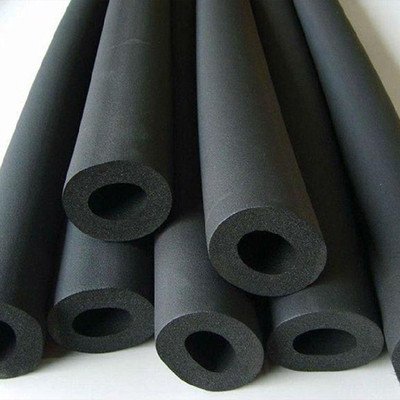
Flexible foam rubber insulation is built for this role. It is a black closed-cell material supplied as slit and unslit tubes or rolls, in several wall thicknesses, and it stays flexible and recovers after bending and light compression. Outdoor runs need a UV-resistant coating or jacket. Our rubber and plastic pipe selection guide covers condensation prevention and B1 flame-retardant grades, and states thermal conductivity of 0.034 W/(m·K) or lower with an operating range of -40°C to 105°C.
Before ordering, send the supplier four details: pipe outside diameter, fluid temperature range, installation location (indoor, ceiling void or outdoor) and any fire-class requirement. A supplier who can match those to a named grade, with test data, is more reliable than one who quotes only a polymer name. Valves, flanges and supports are also worth listing, since pre-cut pieces cover them better than wrapped offcuts.
Conclusion
Synthetic rubber properties are useful for comparing materials, but they are not a purchase specification. Solid-rubber density, generic temperature charts and polymer water ratings only narrow the field. For foam insulation, confirm foam density, thermal conductivity, vapor resistance and the rated temperature range for the exact grade, and choose wall thickness and form from the pipe size and environment.
References
- Kaucuk Istanbul – What is Synthetic Rubber?
- CGR Products – Common Rubber Physical Property Relationship
- WCRP – Rubber Properties Chart
- Goodyear Rubber – Rubber Physical Properties and Characteristics
- Elastoproxy – Service Temperature of Elastomers
- Aerofoam NBR – Technical Data Sheet